
Краткий ответ
For speaker-based Dolby Atmos music monitoring at home you need an interface with at least 12 discrete balanced line outputs for a 7.1.4 layout (seven ear-level speakers, four heights, one LFE). The Focusrite ISA C8X is Focusrite’s first ISA-range USB-C interface: 26-in/28-out, 12 line outs with up to three monitor groups for mono through 7.1.4, two Lundahl ISA transformer preamps plus six Focusrite pres, and the same 24-bit/192 kHz converter class Focusrite uses in RedNet (up to 125 dB dynamic range on the line outs). It fits producers who want capture character and speaker Atmos in one 2U chassis—not the cheapest first immersive step. US list price is about $2,299.99 (regional list prices differ).[1]
What Audio Interface Do You Need for Dolby Atmos at Home?
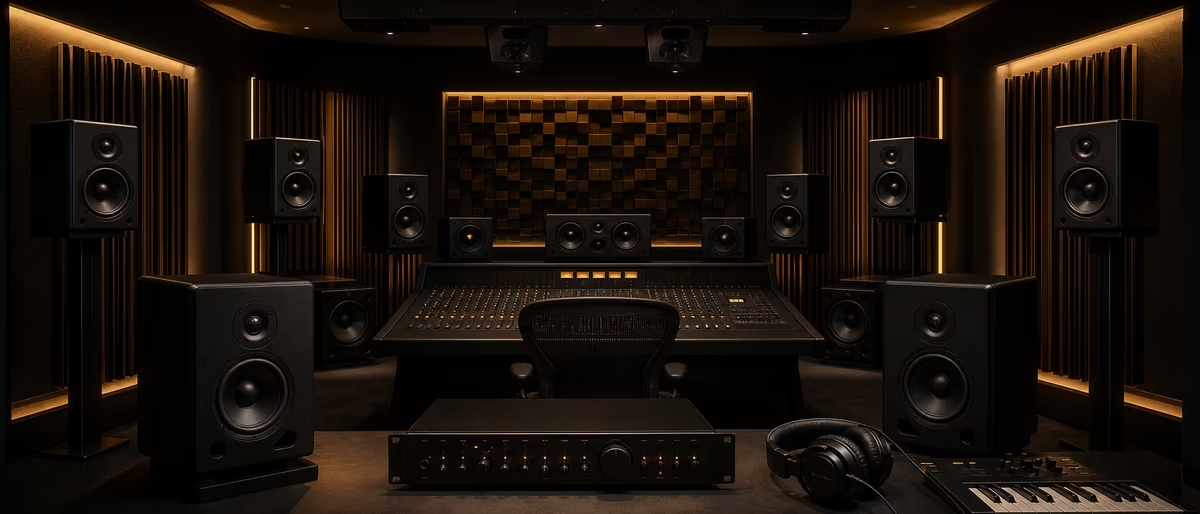
The short hardware answer is I/O count and monitor control, not brand mythology. A practical Atmos music room targets 7.1.4: L/C/R, side and rear surrounds, four height speakers, and a sub/LFE—twelve discrete balanced feeds. Sonarworks’ 2026 home-studio checklist puts the future-proof target at roughly 12–16 outputs when immersive expansion is planned.[2]
Stereo boxes with two or four line outs cannot drive that layout without an external multichannel converter or a second interface. You can still author Atmos objects with binaural headphones, but speaker-critical placement needs a discrete path per channel. Budget Atmos guides make the same cut: enough analog outs plus single-knob multichannel level control and calibration.[3]
The Focusrite ISA C8X sits in that gap as a spring 2026 launch: first USB-C interface in the ISA line, 26×28 simultaneous I/O (including loopback), and twelve balanced line outs marketed from mono through 7.1.4 with three switchable monitor groups via the front panel or Focusrite Control 2.[4][5] For producers scaling from 2.0 beatmaking into Atmos-capable project rooms, the question is whether those twelve outs plus ISA front-end character justify roughly mid-two-thousand-dollar US list pricing versus a lean multichannel converter stack.
Focusrite ISA C8X Specs That Matter for 7.1.4 Monitoring
ISA C8X is a 2U rack centrepiece in Focusrite’s original house blue. Simultaneous I/O is listed at 26×28 including loopback over USB-C (USB 2.0 protocol), with 24-bit/192 kHz conversion and up to 125 dB dynamic range on the line outs—the same converter family Focusrite cites for RedNet.[1][6]
| Feature | ISA C8X (published) | Why it matters for home Atmos |
|---|---|---|
| Analog line outs | 12 balanced; outs 1–2 XLR + TRS | Exact feed count for 7.1.4 speakers |
| Monitor groups | Up to 3 (panel or Control 2) | Stereo nearfields + Atmos array + cue without rewiring |
| Mic preamps | 2× ISA Lundahl LL1538 (79 dB) + 6× Focusrite (69 dB) | Capture character while monitoring immersive |
| Tone (ISA 1–2) | Console + 430 Air (analogue) | Print colour before objects hit the renderer |
| Expansion | ADAT (16 ch @ 44.1/48 kHz), S/PDIF, WC, MIDI | More tracking channels without stealing speaker outs |
| US list price | About $2,299.99 | Premium vs MOTU/ADAT expander stacks; confirm stock |
Twelve line outs are the Atmos headline. You still need a DAW/renderer path that can address those channels (Logic’s built-in Atmos tools, Nuendo/Cubase internal renderers, Studio One spatial export, or a standalone Dolby Atmos Renderer). The interface does not “do Atmos” alone; it supplies clean, switchable speaker feeds and a serious analog front end in one chassis.[7]
When You Actually Need 12+ Outputs
- Stay on stereo + binaural first Learning beds vs objects or checking Spatial references does not require twelve speaker feeds yet. Author and place on headphones, then decide if speakers are worth the room cost.
- Need 12 outs for speaker Atmos Work that must translate on speakers needs discrete 7.1.4 feeds and single-level control—C8X monitor groups or a multi-out converter with software monitor control.
- Need 16 outs headroom 12–16 outs leave room for a second stereo pair, talkback/cue, or later experiments. C8X covers 7.1.4 on analog outs; extra routes still mean careful assignment or an ADAT D/A expander.
- Need ISA more than I/O If you already own 16+ outs but hate the vocal chain, buy a dual ISA-style pre. Choose C8X when you want ISA capture and multichannel monitoring in one unit.
Cheaper Atmos Paths vs the ISA C8X Centrepiece
Budget immersive rooms usually spend more on speakers, stands, cabling, and acoustics than on transformers. Case studies pair multi-out interfaces (for example MOTU 24Ao-class line output boxes), software monitor control, optional multichannel calibration, and Kali LP-6-class arrays—speaker count dominates total cost.[3]
| Path | Interface approach | Strengths | Trade-offs |
|---|---|---|---|
| Budget 7.1.4 stack | Multi-out converter or mid-tier + ADAT DA | Lowest cost per analog out | No ISA tone; monitor control often software-only |
| Hybrid project room | Keep stereo hero; add 8-out ADAT DA | Phased spend, reuses gear | Two boxes, clocking, more cabling |
| ISA C8X centrepiece | Single 2U USB-C, 12 outs, 3 groups | Capture + immersive monitoring + remote control | ~$2.3k US list before speakers |
If the bottleneck is “only two TRS outs,” a cheaper multichannel box plus matched budget nearfields is rational. If you need 7.1.4 monitoring, three speaker groups, eight solid remote preamps, and ISA colour on the lead vocal, C8X collapses that list. Focusrite’s US list is about $2,299.99 (GBP/EUR and rest-of-world USD list figures are also published and can differ); treat that as list, not a guaranteed street price.[6][1]
Do ISA Console and 430 Air Modes Still Matter?
For Atmos monitoring, outs matter more than preamp folklore. For the records you spatialize, channels 1–2 still matter: Lundahl LL1538 transformers, up to 79 dB gain, switchable impedance, balanced inserts, and a 75 Hz HPF—lineage Focusrite traces to the 1985 ISA 110. Six Focusrite preamps at 69 dB add Air and variable Drive for the rest of the session.[1][4]
- Console mode Relay-switched analogue soft-clip for warm saturation and low-end punch. Useful on vocals and aggressive re-amps as a capture decision—not a substitute for bed-bus compression.
- 430 Air mode ISA 430 MkII-style inductor high-shelf shimmer for ribbons, dull condensers, and dusty one-shots; check the stereo downmix after heavy use so height-field brightness does not stack into harshness.
- When modes do not justify the buy Pure ITB sample work barely touches mic preamps. Buy C8X when you track real sources and need 7.1.4 outs—not solely for Air.
Focusrite Control 2 is the modern piece pure vintage ISA outboard lacked: gain, Auto Gain, tone modes, and monitor groups from the mix position or a phone when the rack sits under the desk.[5]
Upgrade Path: From 2.0 Beat Room to Atmos Project Studio
- Treat first reflections, calibrate L/R and headphones, finish masters that travel. Immersive arrays amplify bad rooms.
- Use a native Atmos DAW path or external renderer with binaural monitoring before buying ceiling mounts.[7]
- Map 7.1.4 to twelve interface outputs. If you top out at 2–8 line outs, plan an ADAT D/A expander or a native 12+ out unit such as ISA C8X.
- Matched ear-level arrays beat random thrift surrounds for commercial work. Kali-class full-range pairs are a documented budget path.[3]
- Control 2 groups on C8X or software control on a multi-out converter: one master level, per-speaker trim/delay, then multichannel room correction once the layout is fixed.[2]
- If vocals still need better tone, C8X’s eight remote pres and ISA modes justify the premium. If capture is solved, spend remaining budget on heights, sub, and absorption.
Who Should Buy the Focusrite ISA C8X for Home Atmos?
- Strong fit Producers building a permanent 7.1.4 (or stereo + surround dual) room who also track vocals, guitars, or live sources and want one chassis for capture plus monitor groups.
- Weak fit Strictly stereo beatmaking, pure sample workflows with no mics, or first Atmos experiments still limited to binaural headphones.
- Practical alternative A stable multi-out interface, software monitor control, matched speakers and treatment, plus a separate dual pre when vocals demand it—often cheaper when capture is already solved.
Bottom line: the Focusrite ISA C8X is a coherent 2026 answer when the question is “what single box gives ISA capture and twelve outs for 7.1.4 home monitoring?” The broader Atmos answer remains enough discrete outputs, level control, calibrated speakers, and a renderer-aware DAW—which cheaper multichannel paths can still satisfy.
Building the session side of a stereo-to-Atmos room? Browse free and paid tools, then stock sample libraries that still translate when you open the height field.
Learning path
Связанные хабы ответов
Часто задаваемые вопросы
- What audio interface do you need for Dolby Atmos mixing in a home studio?
- For speaker-based Atmos music, plan on an interface (or interface + DA expander) with at least 12 balanced line outputs for 7.1.4, plus single-level control across all speakers. Software authoring can start earlier with binaural headphones. The Focusrite ISA C8X ships with twelve line outs and three monitor groups for mono through 7.1.4.[1][2]
- Does the Focusrite ISA C8X support 7.1.4 monitoring?
- Yes. Focusrite documents twelve balanced line outputs from mono to 7.1.4, with up to three monitor groups from the front panel or Focusrite Control 2. Outputs one and two are available on both XLR and TRS.[1][5]
- How many outputs do you need for a 7.1.4 Atmos speaker setup?
- A full 7.1.4 music layout uses twelve feeds: seven ear-level channels, four height channels, and one LFE/sub. Sonarworks’ 2026 checklist suggests 12–16 outputs for immersive headroom beyond the minimum layout.[3][2]
- Is the ISA C8X worth it only for the preamps?
- Usually no. The two Lundahl ISA preamps with Console and 430 Air modes are a real capture upgrade, but at roughly $2,300 US list you also pay for twelve outs, eight remote preamps, conversion, and monitor groups. For transformer tone alone, standalone dual-channel preamps are more targeted.[6]
- What is cheaper than the ISA C8X for home Atmos monitoring?
- Common budget paths use a multichannel line-output interface or a mid-tier interface plus ADAT D/A expander, then software monitor control and affordable full-range speakers such as Kali LP-series arrays. You trade away ISA transformers and hardware monitor groups for lower cost per output.[3]
- Do Console and 430 Air modes affect Atmos mixes?
- They colour the analog path into the converters on the two ISA channels, not the renderer math. Use them as print/capture choices for vocals and instruments that later become objects or bed content, then verify stereo and binaural downmixes so bright Air or Console soft-clip does not surprise the fold-down.
- Can you mix Dolby Atmos without 12 speakers?
- Yes for learning and many prep workflows: binaural monitoring in the Dolby renderer path (including Logic’s built-in Atmos tools) lets you place objects and check rough translation. Speaker-critical commercial work still benefits from a calibrated multichannel room before final QC.[7]
- What software ships with the ISA C8X?
- As standard, Focusrite includes Hitmaker Expansion (with Brainworx bx_console Focusrite SC among other tools) and Sonnox Oxford Reverb. Optional Sonnox ISA Essentials and Elite Oxford-plugin bundles are sold as upgrades. Plugin bundles do not replace a multichannel monitor controller or Atmos renderer.[5][1]